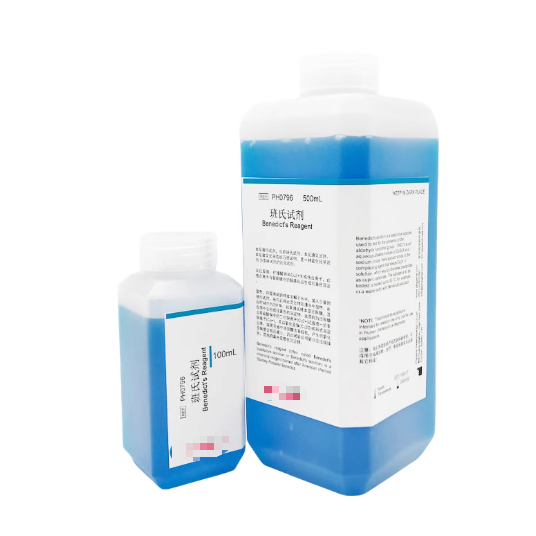
Reaction principle: Sodium citrate and Cu2+ form complex ions, which react with the aldehyde group in glucose to form a red-yellow precipitate.
First, dissolve the sample to be tested in water, add a small amount of Benedict’s reagent, shake well, and heat the mixture in boiling water. The reaction time is approximately 3 minutes. If the test sample is a reducing sugar, a reddish-yellow precipitate will form in the mixture. This is because the reducing sugar reduces the divalent cupric ions (Cu2+) in the copper sulfate to monovalent cuprous ions (Cu+), which precipitate as cuprous oxide (Cu20). If the reducing sugar content of the solution is low, less cuprous oxide will be produced, resulting in a green, turbid yellow, or orange precipitate.
Identification of Reducing Sugars
1. Take a test tube and inject 2 mL of the sample to be tested.
2. Inject 2 mL of Benedict’s reagent into the test tube.
3. Place the test tube in a large beaker of boiling water and heat with an alcohol burner for approximately 2 minutes.
4. Observe the color of the solution.
Results
Non-reducing sugars such as sucrose, starch, and cellulose are negative. Reducing sugars such as glucose, fructose, and galactose are positive.
Store at room temperature and have a shelf life of 12 months.