Address
Room 2301C, 23rd Floor, Building 1, jinghu Commercial center, No, 34, Liangzhuang Street, Eri District, Zhengzhou City, Henan province
Work Hours
Monday to Friday: 7AM - 7PM
Weekend: 10AM - 5PM
Address
Room 2301C, 23rd Floor, Building 1, jinghu Commercial center, No, 34, Liangzhuang Street, Eri District, Zhengzhou City, Henan province
Work Hours
Monday to Friday: 7AM - 7PM
Weekend: 10AM - 5PM

I. Introduction
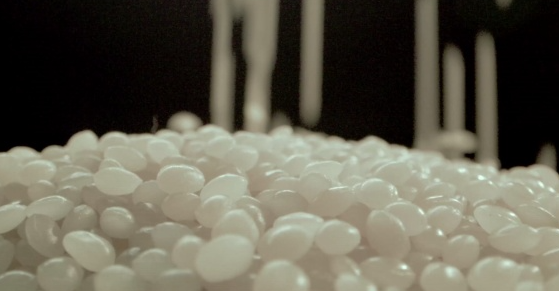
Polyhydroxyalkanoates (PHA) are a class of biodegradable polyesters synthesized by various microorganisms using renewable carbon sources. In the early 20th century, Poly(3-hydroxybutyrate) (P3HB) was first discovered in Azotobacter chroococcum. This substance can be stored within microbial cells as a stable carbon source, and this unique storage mechanism has attracted widespread attention.
II. Structure of Polyhydroxyalkanoates (PHA)
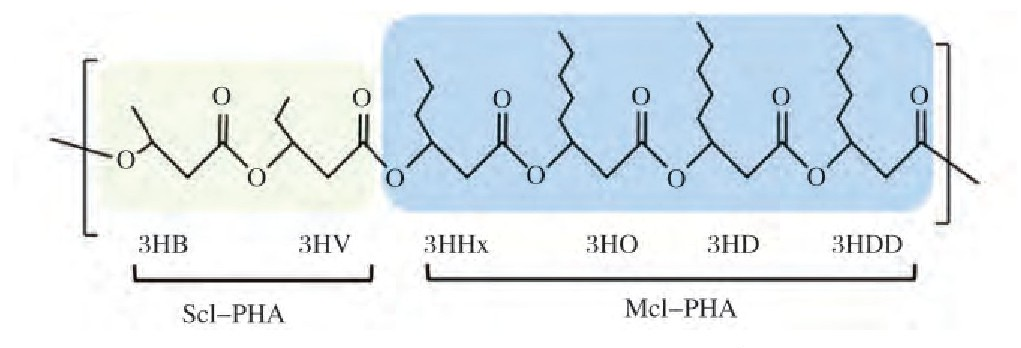
Polyhydroxyalkanoates (PHA) is polymerized from linear hydroxyalkanoic acids (HA). According to the length of the alkyl side chain, PHA can be classified into three categories: short-chain-length PHA (scl-PHA), containing 3–5 carbon atoms; medium-chain-length PHA (mcl-PHA), containing 6–14 carbon atoms; and long-chain-length PHA (lcl-PHA), containing more than 14 carbon atoms.
Shows the monomers of scl-PHA and mcl-PHA. The monomers of scl-PHA include 3-Hydroxybutyrate (3HB) and 3-Hydroxyvalerate (3HV), while the monomers of mcl-PHA include 3-Hydroxyhexanoate (3HHx), 3-Hydroxyoctanoate (3HO), 3-Hydroxydecanoate (3HD), and 3-Hydroxydodecanoate (3HDD).
III. Polyhydroxyalkanoates (PHA) Products and Their Properties
1.P3HB
Poly(3-hydroxybutyrate) (P3HB) in short-chain-length Polyhydroxyalkanoates (PHA) is the first-generation industrialized product. It has a melting point of 180°C and a glass transition temperature around 0°C, with high strength and hardness, making it a typical brittle material.
2.PHBV
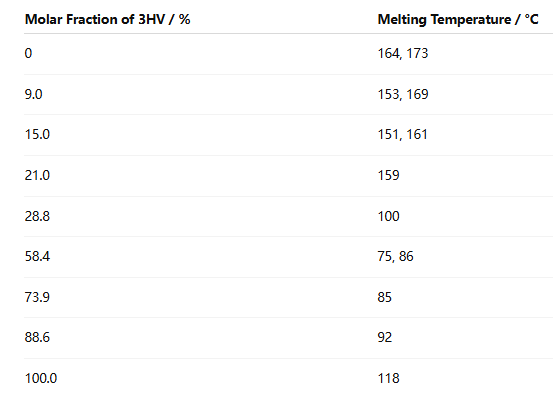
By introducing 3-Hydroxyvalerate (3HV) monomers during the polymerization process, the second-generation product Poly(3-hydroxybutyrate-co-3-hydroxyvalerate) (PHBV) was obtained, which improved the toughness of Poly(3-hydroxybutyrate) (P3HB) and increased the elongation at break to 15%–20%.
In research, the molar fraction of 3HV monomers is usually controlled below 30%, because when it exceeds 30%, the elongation at break of the material decreases significantly instead. At the same time, the melting temperature of the material shows a clear downward trend.
3.PHBHHx
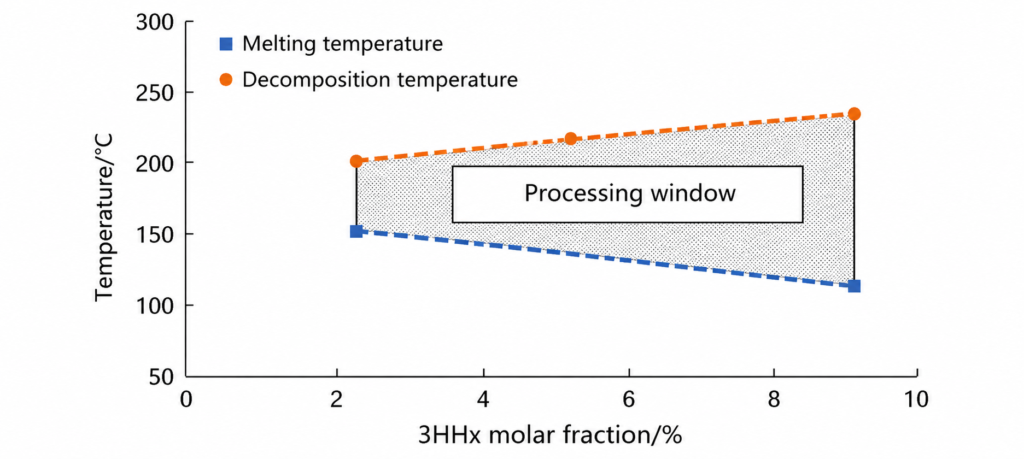
By introducing 3-Hydroxyhexanoate (3HHx) into the polymer chain through copolymerization, the third-generation product Poly(3-hydroxybutyrate-co-3-hydroxyhexanoate) (PHBHHx) was obtained. As the molar fraction of 3HHx increases, the glass transition temperature, melting point, and crystallinity of PHBHHx decrease, while the thermal degradation temperature increases. When the molar fraction of 3HHx increases from 2.5% to 9.5%, the thermal degradation temperature rises by nearly 30°C, significantly broadening the processing temperature window and improving the material’s processing performance.
4.P34HB
By introducing 4-Hydroxybutyrate (4HB), the fourth-generation product Poly(3-hydroxybutyrate-co-4-hydroxybutyrate) (P34HB) was obtained. When the molar fraction of 4HB increased from 0 to 16%, the toughness of the material improved significantly, with the elongation at break increasing from 5% to 444%, while the crystallinity decreased from 60% to 45%.
IV. Production Process of Polyhydroxyalkanoates (PHA)
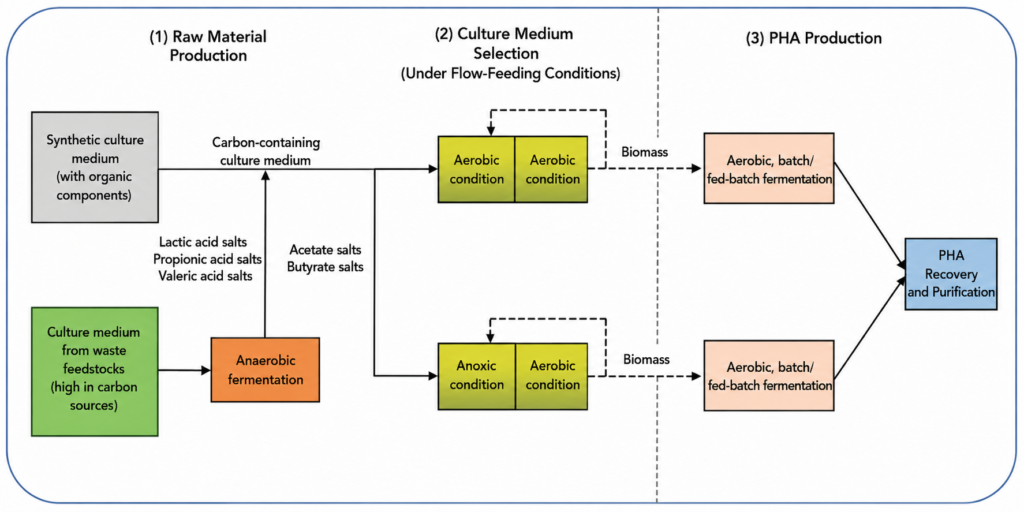
The principle driving PHA accumulation in MMC
The key factor affecting Mixed Microbial Cultures (MMC)-based Polyhydroxyalkanoates (PHA) production is the screening of PHA-accumulating strains. The PHA production process based on MMCs is illustrated in the figure. Most studies describe PHA storage by high-yield strains in MMC systems as occurring during aerobic carbon transient processes. The production of high-value-added products, such as biochemicals and biomaterials, using the ecological selection principles of MMCs has been defined as ecological biotechnology.
When cultured under conditions lacking electron donors or acceptors (such as carbon sources or O₂), or lacking external nutrients (such as nitrogen or phosphorus sources), intracellular PHA can be preserved as an energy or carbon storage material.
V. Application Prospects of PHA
1.Biomedical field
Polyhydroxyalkanoates (PHA) has good biocompatibility and low toxicity. Poly(3-hydroxybutyrate-co-4-hydroxybutyrate) (P34HB) can be used as a material for surgical sutures, and its products have passed U.S. food and drug safety certification. In addition, PHA possesses biodegradability and certain mechanical strength, allowing it to partially replace tissues such as skin, cardiovascular tissue, and cartilage, and it can also be prepared as bone tissue scaffolds.
2.Packaging materials field
Polyhydroxyalkanoates (PHA) materials exhibit high gas barrier properties and excellent biodegradability. Arrieta et al. prepared a Poly(3-hydroxybutyrate) (PHB)/Polylactic Acid (PLA)/acetyl tributyl citrate composite material using electrospinning technology for packaging applications.