Address
Room 2301C, 23rd Floor, Building 1, jinghu Commercial center, No, 34, Liangzhuang Street, Eri District, Zhengzhou City, Henan province
Work Hours
Monday to Friday: 7AM - 7PM
Weekend: 10AM - 5PM
Address
Room 2301C, 23rd Floor, Building 1, jinghu Commercial center, No, 34, Liangzhuang Street, Eri District, Zhengzhou City, Henan province
Work Hours
Monday to Friday: 7AM - 7PM
Weekend: 10AM - 5PM

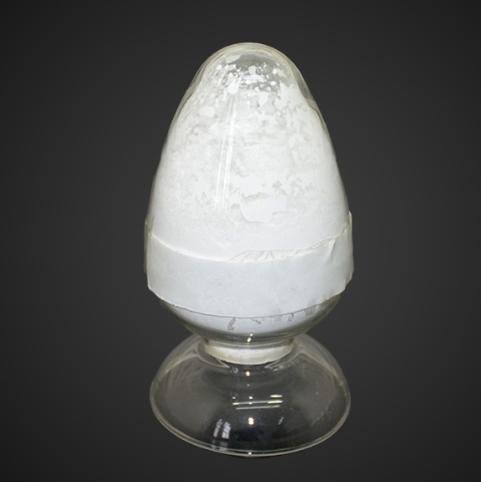
What is boehmite?
For a long time, determining the crystal structure of boehmite proved difficult due to its non-uniform structure and water content, presenting a challenge in the field of structural chemistry. It is now generally accepted that boehmite contains one molecule of water of crystallization—represented by the chemical formula γ-Al₂O₃·H₂O or γ-AlOOH—and is classified as a type of aluminum oxide hydrate.
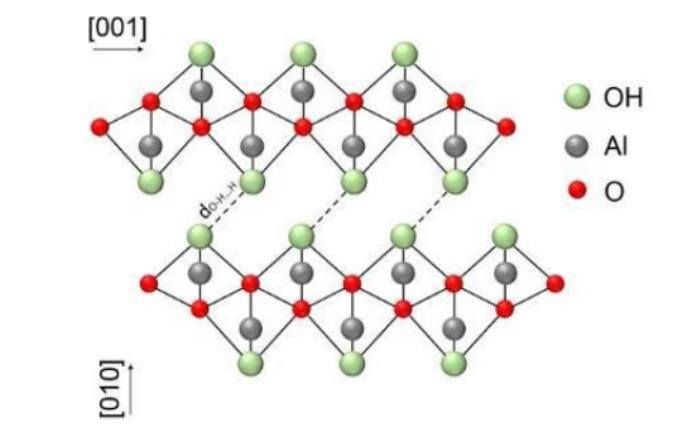
Boehmite is composed of sheets of edge-sharing Al-(O, OH) octahedra; oxygen atoms are distributed at the corners shared by four octahedra, while hydroxyl groups are located at the corners shared by two octahedra. These octahedra form the individual structural layers of boehmite, and the hydroxyl groups on the sides link the γ-AlOOH layers in an ordered manner via hydrogen bonding, resulting in a layered structure.
Why is it called boehmite?
Boehmite is also known as boehmite (or sometimes referred to as alpha-AlOOH in older literature, though γ-AlOOH is the correct designation). In 1925, the German chemist Johann Böhm first discovered γ-AlOOH and identified it as a major constituent of bauxite. In 1927, de Lapparent analyzed bauxite from the Provence region, confirmed this finding, and named the mineral composed of γ-AlOOH “boehmite.”
Are there different types of boehmite?
Based on crystallinity, boehmite can be broadly categorized into two types—high-crystallinity boehmite and low-crystallinity boehmite—which differ in their structures and applications.
What is the relationship between boehmite and aluminum oxide?
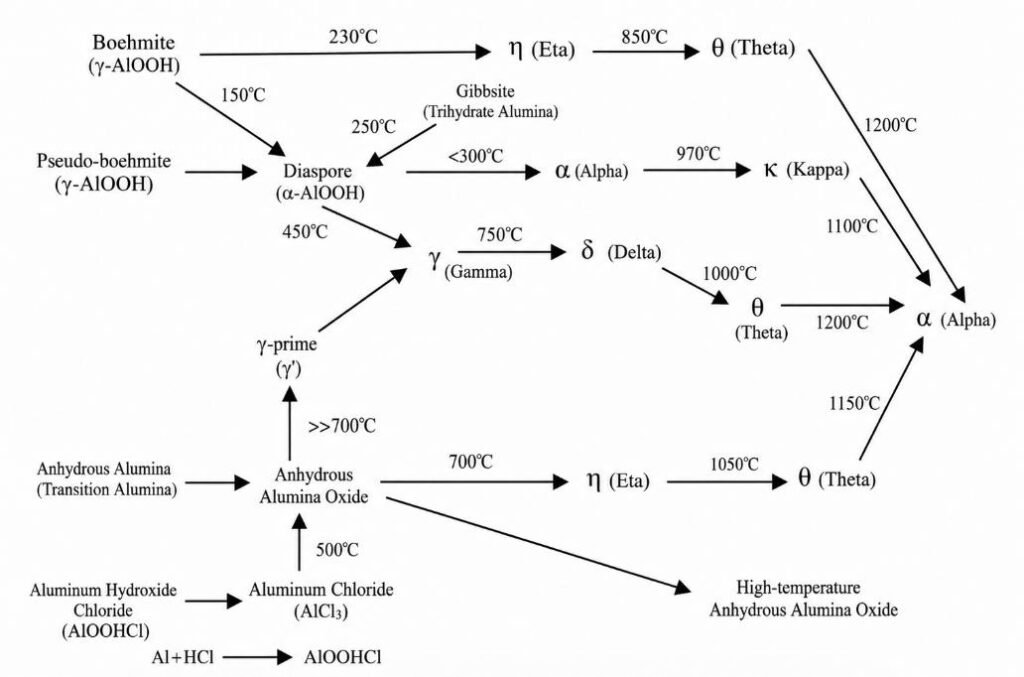
Alumina exhibits numerous polymorphs; during the calcination of alumina hydrates, metastable phases such as χ, ρ, γ, κ, δ, and θ, as well as the stable α-phase, can emerge. Phase transformation diagrams for alumina and its hydrates indicate that boehmite is a key precursor to γ-Al₂O₃.
What are the morphologies of boehmite?
Research has shown that γ-AlOOH possesses unique chemical properties and pore structures; it exhibits various morphologies—such as spherical, hollow spherical, and nanofibrous forms—all of which demonstrate certain adsorption capabilities.
What are the primary application scenarios for boehmite?
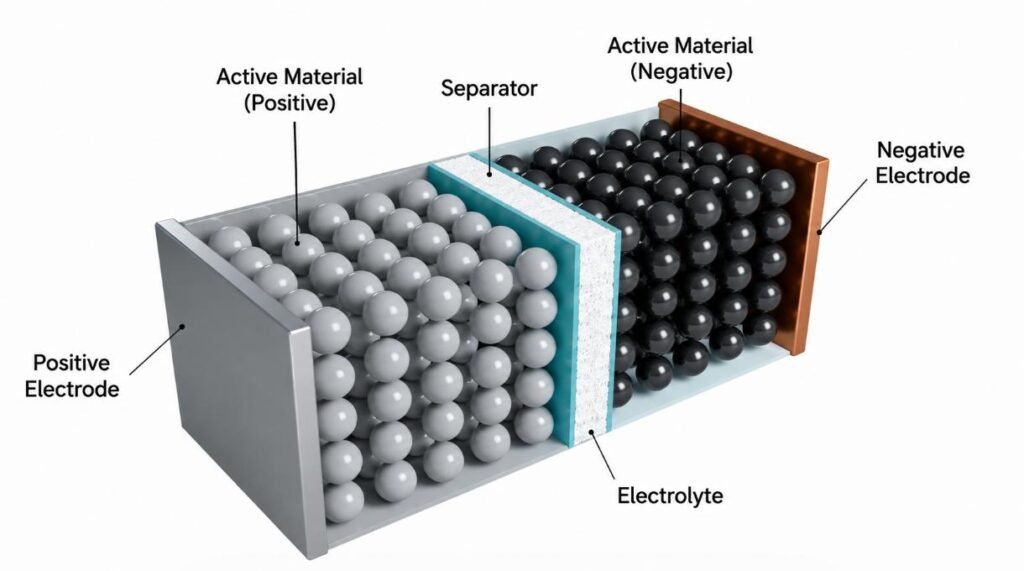
Boehmite is primarily used for coating separators and electrode sheets in lithium-ion battery cells. Coating the separator enhances its heat resistance and puncture resistance, thereby improving the battery’s safety. Coating the electrode sheets prevents burrs—generated during the slitting process—from puncturing the separator, which also boosts safety, optimizes production processes, and increases energy density. Furthermore, thanks to characteristics such as low magnetic impurity content, low water absorption, low specific gravity, and low Mohs hardness, boehmite helps improve rate capability and cycle life, increases the yield rate of battery cells, and reduces self-discharge during use, making it a crucial material for enhancing the safety and reliability of lithium-ion batteries.
What are the advantages of boehmite compared to aluminum oxide?
(1) Boehmite has lower hardness, which reduces equipment wear and the risk of introducing foreign matter during processing;
(2) Boehmite features a narrower particle size distribution, controllable specific surface area, and low specific gravity; for the same weight, it covers a larger area than alumina, effectively reducing coating costs;
(3) Boehmite has lower water absorption, making it easier to maintain the dryness of the separator;
(4) Coatings made with boehmite offer high uniformity and low internal resistance; the material enables low energy consumption and is more environmentally friendly during production.
What are the methods for preparing boehmite?
Since the 1950s and 1960s, continuous improvements to the traditional Bayer process have enhanced product purity and significantly improved the performance of boehmite in applications, prompting researchers to develop various methods for preparing nano-boehmite. Currently, the primary preparation methods include direct aluminum hydrolysis, organic alkoxide hydrolysis, the sol-gel process, and hydrothermal synthesis.
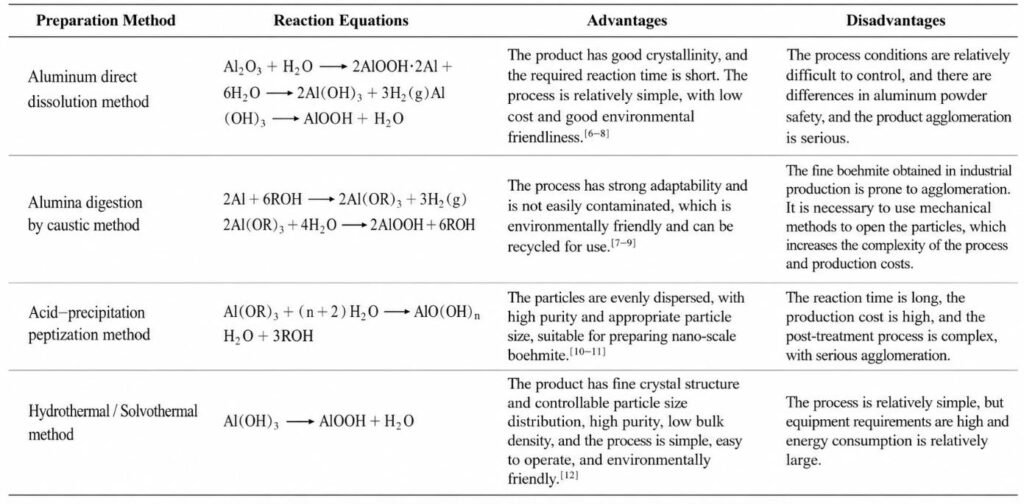
Among the various methods available, the hydrothermal method offers distinct advantages in controlling the microscopic morphology and micro-to-nano scale dimensions of boehmite powders; characterized by operational simplicity and environmental friendliness, it is hailed as a highly promising approach for green synthesis. While research into the hydrothermal preparation of nano-boehmite powders has yielded significant results, reports from both domestic and international sources predominantly rely on relatively expensive aluminum salts or aluminum alkoxides as precursors. The high cost of these raw materials has hindered the method’s progress toward industrialization.
Besides being used for coating lithium-ion battery separators, what other applications does boehmite have?
Its high specific surface area, high porosity, and ability to retain its original morphology after phase transformation make it a key raw material for producing rapid, efficient, and reusable adsorbents.
Its remarkable biocompatibility allows it to excel in orthopedics, dentistry, and biomedical applications.
Its high solubility and excellent dispersibility—stemming from low density and a unique biochemical structure—enable it to impart superior mechanical properties, thermal degradation resistance, barrier performance, and wear resistance when used as an ultrafine powder filler.
Its inherent flame retardancy, good filling characteristics, and resistance to electrical leakage make it widely applicable in high-performance, ultra-thin copper-clad laminates.
Its stable orthorhombic structure and high density of surface hydroxyl groups allow for surface modification with various functional groups, making it a valuable raw material for producing high-value supported catalysts and reagents.
What is the market situation for boehmite?
Data from the GGII (Gaogong Industry Institute) shows that, driven by increases in shipments of both power lithium batteries and coated separators, China’s shipments of boehmite for lithium-ion battery separators reached 32,000 tons in 2022, a year-on-year increase of over 70%.
GGII forecasts that China’s shipments of boehmite for lithium-ion battery separators will exceed 50,000 tons in 2023—a year-on-year rise of over 60%—due to the following factors:
(1) Rapid growth in the new energy vehicle and energy storage sectors is expected to drive the growth rate of lithium-ion battery shipments to over 70%;
(2) The superior coating performance of boehmite, combined with cost reductions resulting from technological advancements and large-scale production, will further boost the penetration rate of boehmite in lithium-ion battery applications.
Related Product
For industrial applications and high-purity grades,see our Low Na₂O Pseudo Boehmite .