Address
Room 2301C, 23rd Floor, Building 1, jinghu Commercial center, No, 34, Liangzhuang Street, Eri District, Zhengzhou City, Henan province
Work Hours
Monday to Friday: 7AM - 7PM
Weekend: 10AM - 5PM
Address
Room 2301C, 23rd Floor, Building 1, jinghu Commercial center, No, 34, Liangzhuang Street, Eri District, Zhengzhou City, Henan province
Work Hours
Monday to Friday: 7AM - 7PM
Weekend: 10AM - 5PM

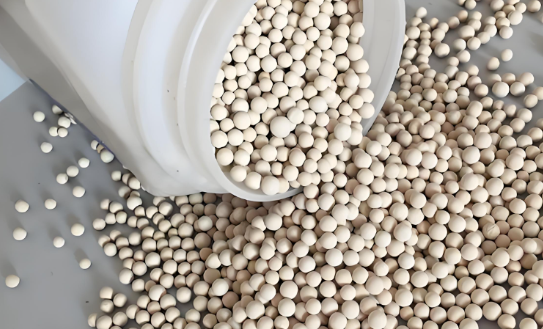
Desiccant
In organic experiments, the need to dry liquid organic compounds is often encountered, primarily to remove small amounts of water or other solvents present in the compounds. In practice, this drying objective can often be achieved by selecting an appropriate desiccant.
Common desiccants are mostly anhydrous inorganic salts or inorganic oxides. Some, such as calcium chloride, magnesium sulfate, and sodium sulfate, combine with water to form hydrates, which act as desiccant. Others, such as phosphorus pentoxide and calcium oxide, react chemically with water to form another compound, which also acts as a desiccant.
This article primarily summarizes the characteristics and applicable ranges of desiccants commonly used in experiments.
1.Desiccant selection
1) The desiccant must not chemically react with the material being dried.
2) Liquid desiccant must not be miscible with the material being dried and must have a different density.
3) The desiccant must be able to separate from the material being dried after contact with water.
4) The substance formed by the desiccant’s reaction with water must not react with the material being dried.
5) Fully consider the desiccant’s drying capacity, drying speed, and price.
2.Notes
1) Desiccant Dosage
① Avoid excessive desiccant use; otherwise, the substance being dried will be lost due to adsorption on the solid desiccant surface.
② If the amount of desiccant is insufficient, the added desiccant will dissolve in the adsorbed water. The desiccant dosage should be determined based on the desiccant’s impurity removal capacity and the solubility of water in the solution being dried.
For example, compounds containing hydrophilic groups (such as alcohols, ethers, and amines) generally have a higher solubility in water, so more desiccant should be added. In practice, due to experimental time constraints, the amount of desiccant used is often significantly greater than the theoretical value.
2) Desiccant Particle Size
① Particles too large: Surface area is small, resulting in poor water absorption.
② Particles too small: Particles tend to form a slurry during drying, making separation difficult.
Desiccant particles should be neither too large nor too powdery.
3) Several signs that indicate a solution is “dry”
① If the solution contains water, the desiccant will typically be clumped and adhere to the bottle wall.
② For solutions containing more water, the desiccant will clearly dissolve in the aqueous phase, forming separate layers.
③ For a “dry” solution, the desiccant will typically be able to move freely at the bottom of the bottle, and the solution will be clear and transparent.
3.Commonly used desiccants
1) Anhydrous Calcium Chloride (CaCl2)
Advantages:
① Strong absorption capacity (below 30°C, forms CaCl2·6H2O);
② Inexpensive;
③ In addition to water, anhydrous calcium chloride can also absorb methanol and ethanol.
Limitations:
① Cannot be used with most oxygen- or nitrogen-containing compounds; may react with alcohols, phenols, amides, or other carbonyl-containing organic compounds to form complexes.
② Cannot dry acidic substances. This is because anhydrous calcium chloride often contains a certain amount of calcium hydroxide.
2) Anhydrous Magnesium Sulfate (MgSO4)
Advantages:
① Neutral desiccant with strong absorption capacity;
② Inexpensive;
③ Can be used for many substances that calcium chloride cannot dry, such as aldehydes and certain esters.
Limitations:
① May cause rearrangement of compounds, such as epoxides;
② Anhydrous magnesium sulfate has fine particles, requiring care when filtering.
3) Anhydrous Potassium Carbonate (K2CO3)
Advantages:
① Alkaline desiccant with average absorption capacity;
② Generally used for the initial drying of water-soluble alcohols and ketones.
Limitations:
① Slow drying speed;
② Inability to dry acidic substances.
4) Anhydrous Sodium Sulfate (Na₂SO₄)
Advantages:
① Neutral desiccant with excellent drying effect (below 32.4°C, it forms Na₂SO₄•10H₂O);
② Wide range of applications;
③ Granular form, allowing the solution to be directly decanted and separated after drying;
④ Easy to determine if the appropriate amount of desiccant is added. It tends to clump when excess water is present.
Limitations:
① Slow water absorption, making complete water removal difficult; only preliminary drying is possible;
② Must be used at room temperature; cannot be used with boiling solvents.
Na₂SO₄•10H₂O decomposes at 32.4°C.
5) Anhydrous Calcium Sulfate (CaSO₄)
Advantages:
① Fast and complete drying;
② Forms a stable hydrate with water (2CaSO₄ • H₂O).
Limitations:
① Low water absorption.
6) Sodium Metal (Na)
Features:
① Commonly used with ether, aliphatic hydrocarbons, or aromatic hydrocarbons;
② When using, sodium metal should be sliced into thin slices to increase the contact surface.
7) Molecular sieves
Features:
① Commonly used to adsorb small amounts of water from solvents such as ether, ethanol, isopropanol, or chloroform;
② Newly purchased molecular sieves require activation (drying at 500°C under atmospheric pressure for 2 hours).
Excessively high or low temperatures will affect adsorption capacity, and temperatures exceeding 600°C will destroy the molecular sieve’s crystal structure.
Commonly used desiccants for various organic substances
| Organic matter | Desiccant |
| Alcohols | Anhydrous potassium carbonate, anhydrous magnesium sulfate, anhydrous calcium sulfate, quicklime |
| Alkyl halides, aromatic halides | AAnhydrous calcium chloride, anhydrous sodium sulfate, anhydrous magnesium sulfate, anhydrous calcium sulfate, phosphorus pentoxide |
| Ethers, alkanes, aromatic hydrocarbons | Anhydrous calcium chloride, metallic sodium, anhydrous calcium sulfate, phosphorus pentoxide |
| Aldehydes | Anhydrous sodium sulfate, anhydrous magnesium sulfate, anhydrous calcium sulfate |
| Ketones | Anhydrous potassium carbonate, anhydrous sodium sulfate, anhydrous magnesium sulfate, anhydrous calcium sulfate |
| Esters | Anhydrous sodium sulfate, anhydrous magnesium sulfate, anhydrous calcium sulfate |
| Organic bases (amines) | Solid potassium hydroxide or sodium hydroxide, quicklime, barium oxide |
| Organic acids | Anhydrous sodium sulfate, anhydrous magnesium sulfate, anhydrous calcium sulfate |