Address
Room 2301C, 23rd Floor, Building 1, jinghu Commercial center, No, 34, Liangzhuang Street, Eri District, Zhengzhou City, Henan province
Work Hours
Monday to Friday: 7AM - 7PM
Weekend: 10AM - 5PM
Address
Room 2301C, 23rd Floor, Building 1, jinghu Commercial center, No, 34, Liangzhuang Street, Eri District, Zhengzhou City, Henan province
Work Hours
Monday to Friday: 7AM - 7PM
Weekend: 10AM - 5PM

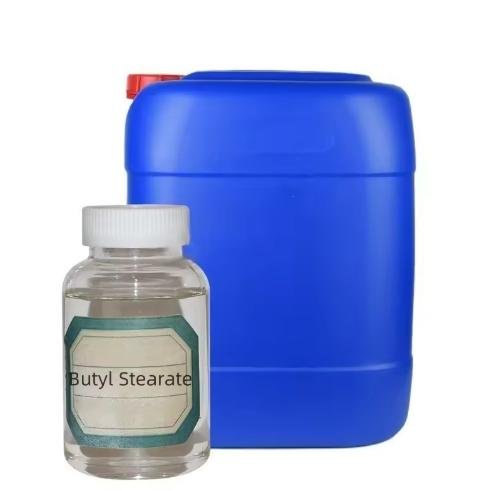
Butyl stearate is an organic compound widely used in the plastics industry (especially in PVC processing) as a lubricant and processing aid. Physical properties: Particularly suitable for high-transparency products.
– Internal Lubrication
– The polar ends (ester groups) of butyl stearate molecules interact with the PVC molecular chains, reducing friction between resin particles and improving melt flowability.
– Reduces degradation caused by shear heat during processing, improving processing efficiency (e.g., extrusion, calendering speed).
– Reduces PVC melt viscosity, decreasing torque and energy consumption.
– Forms a lubricating film at the interface between the melt and processing equipment (e.g., screw, die), preventing adhesion, reducing surface roughness, and enhancing product gloss.
– Allows processing at lower temperatures, avoiding thermal decomposition caused by high temperatures (e.g., HCl release).
– As an auxiliary plasticizer, adding a small amount can improve the flexibility of PVC, but the effect is weaker than that of primary plasticizers (e.g., DOP).
– Promotes the dispersion of fillers (e.g., calcium carbonate), reducing agglomeration.
– Improves the surface smoothness of the final product, reducing defects such as fisheyes and flow marks.
– In transparent PVC products, appropriate use can reduce haze and improve transparency. – When used in conjunction with heat stabilizers (such as calcium-zinc stabilizers), it can delay PVC decomposition.
– When compounded with external lubricants such as paraffin wax and polyethylene wax, it optimizes the balance of the lubrication system.
|
Specification
|
Item
|
|
Appearance
|
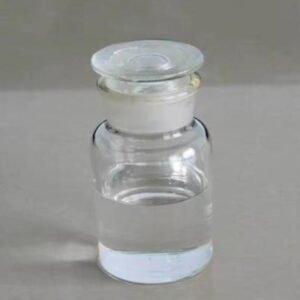
Colorless transparent liquid at room temperature
|
|
Acid value KOHmg/g
|
≤1.0
|
|
Relative density
|
0.85
|
|
Flash point ℃
|
≥185
|
|
Moisture content %
|
≤0.01
|
|
Ester content %
|
≥99
|
|
Chroma(Pt-Co)
|
≤50
|
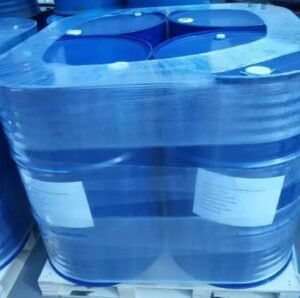
Package:200kg