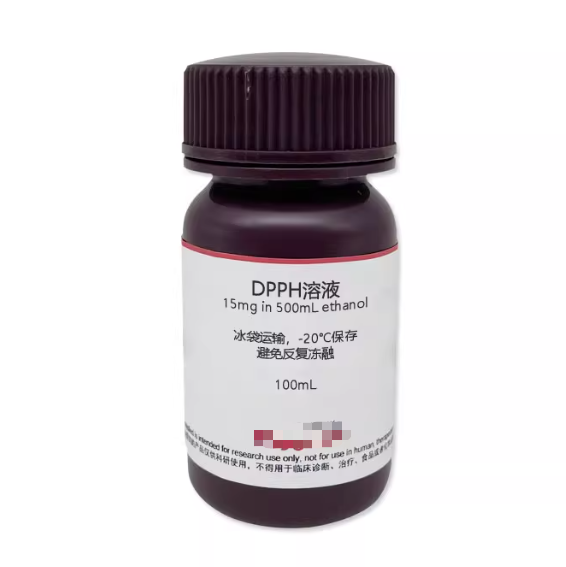
DPPH assay: Developed in 1958, the DPPH assay is widely used to quantitatively determine the antioxidant capacity of biological samples, classified substances, and foods. DPPH is a stable free radical in organic solvents. Its alcoholic solution is purple and must be stored at low temperatures and away from light. It has a single electron and can accept an electron or hydrogen ion, with a maximum absorption at a wavelength of 517 nm. In the presence of a free radical scavenger, DPPH’s single electron is captured, causing its color to lighten. The absorbance at the wavelength of maximum absorption decreases linearly, and a decrease in absorbance indicates an increase in antioxidant activity, thereby evaluating the antioxidant capacity of the test sample. This antioxidant capacity is expressed as an inhibition rate; a higher inhibition rate indicates a stronger antioxidant.
Storage: Transport in ice packs and store frozen at -20°C. Valid for 6 months. Use promptly after opening.
Note: For laboratory research use only.
To prepare the DPPH test solution, dissolve 1 mg of solid DPPH in 24 mL of 95% ethanol (or anhydrous ethanol or methanol). Ultrasonicate for 5 minutes and shake thoroughly to ensure uniformity between the upper and lower portions. Store in the dark and use within 5 hours. Take 1 mL of the DPPH solution prepared above and dilute it with 0.5 mL of 95% ethanol (or anhydrous ethanol or methanol) to an absorbance between 0.6 and 1.0. If the absorbance is too high, continue adding solvent. If the absorbance is too low, add more DPPH solid or the original solution.
Sample Preparation
Dissolve the sample in an appropriate solvent. For ease of calculation, prepare a concentration of 1 mg/mL. The solvent should be selected based on the polarity of the sample. Methanol, 95% ethanol, or anhydrous ethanol (preferably the same solvent as used for the DPPH solution) are preferred. If the sample is insoluble, DMSO can be used.
Preliminary Test
Take 1.0 mL of DPPH solution, add 0.5 mL of the appropriate organic solvent, and then add a small amount of sample solution. Add the sample gradually, mixing gradually and observing the discoloration of the solution. When the color of the solution has mostly faded, record the sample volume added. If the reaction is slow, place the sample in a 37°C oven for half an hour.
This volume is the maximum sample volume. Set five additional volumes based on this maximum volume to form an arithmetic progression.
For example, during the preliminary test, if the color of the DPPH solution fades substantially after adding 500 μL of sample solution, then 500 μL is the maximum sample volume. For this sample, the appropriate volume gradient should be 100 μL, 200 μL, 300 μL, 400 μL, and 500 μL.
A0 value: Add 1.0 mL of DPPH solution to a cuvette, add 0.5 mL of the corresponding organic solvent, dilute and mix, and measure the A value. This A value is A0 (A0 must be between 0.8 and 1.0).
A value: Add (500 – x) μL of organic solvent to a cuvette, add xuL of sample solution (x is the sample volume determined based on the preliminary test results in 1.3), then add 1.0 mL of DPPH solution and mix until the total reaction volume is 1.5 mL. Measure the A value.
Precautions for Use
1. Before measurement, zero the solution with a blank solvent.
2. After injecting the solution into the cuvette, shake thoroughly to ensure even color distribution.
3. Ensure the cuvette is clean before and after each use.
4. If the A value is greater than A0 during the experiment, it may be due to background absorption from the sample itself. In this case, the A value (Abase) of this background absorption should be subtracted. This Abase value can be measured by adding sample but not DPPH.