Address
Room 2301C, 23rd Floor, Building 1, jinghu Commercial center, No, 34, Liangzhuang Street, Eri District, Zhengzhou City, Henan province
Work Hours
Monday to Friday: 7AM - 7PM
Weekend: 10AM - 5PM
Address
Room 2301C, 23rd Floor, Building 1, jinghu Commercial center, No, 34, Liangzhuang Street, Eri District, Zhengzhou City, Henan province
Work Hours
Monday to Friday: 7AM - 7PM
Weekend: 10AM - 5PM

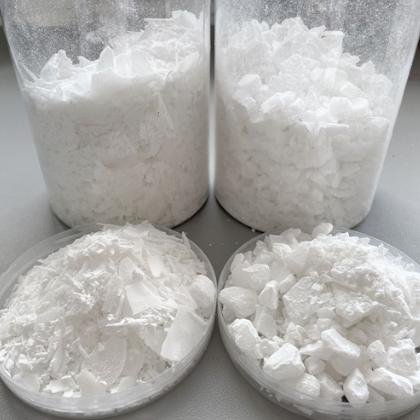
1.The Core Mechanism of Silane Coupling Agents
General Formula for Silane Coupling Agents: Y-R-SiX₃
X (Hydrolyzable Group): Methoxy (-OCH₃) or ethoxy (-OC₂H₅); upon hydrolysis, it generates silanol (Si-OH), which then undergoes condensation with the surface hydroxyl groups of inorganic fillers (such as precipitated silica).
R (Linking Chain): A short-chain alkyl group (e.g., propyl) that provides molecular flexibility.
Y (Organic Functional Group): An active group (e.g., thiol, vinyl, amino, or epoxy) capable of forming chemical bonds or engaging in physical interactions with the rubber polymer.
Key Parameters for Silanization Reactions:
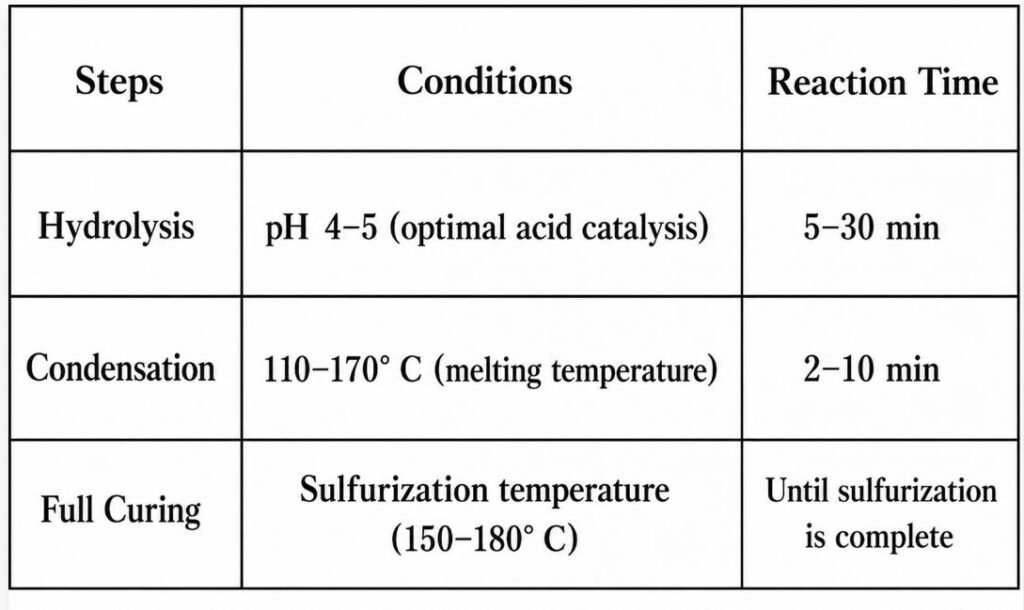
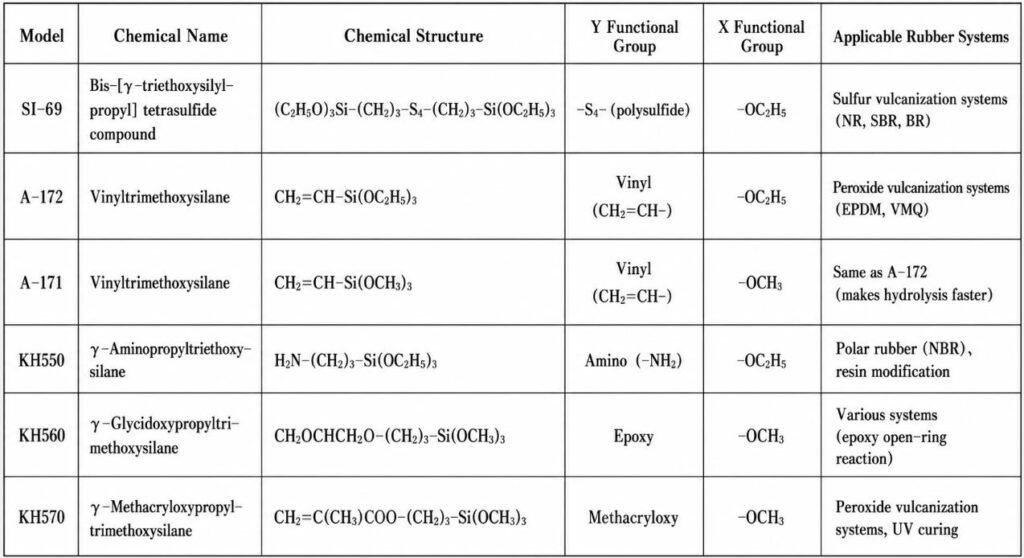
2.Comparison of Structures and Properties of Major Silane Coupling Agents
3.Differences Between Sulfur Vulcanization and Peroxide Vulcanization Systems
(1) Sulfur Vulcanization Systems (e.g., NR/SBR Tire Compounds)
Key Coupling Agent: SI-69
Mechanism:
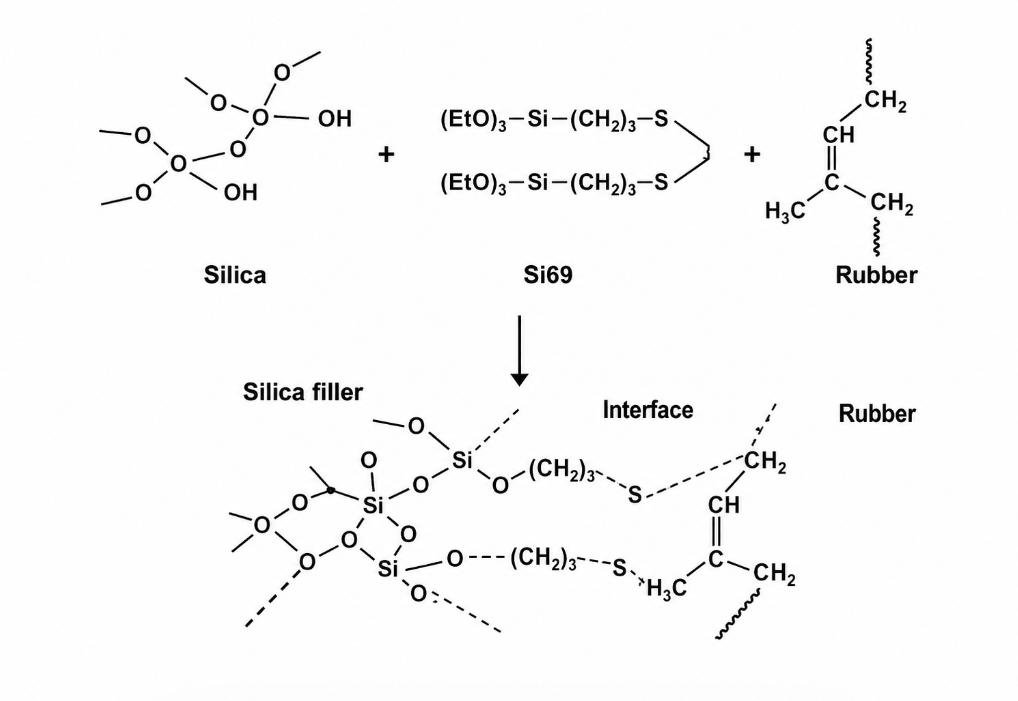
Polysulfide linkages (–S₄–) participate in the sulfur crosslinking network, forming covalent bonds between the rubber, coupling agent, and filler (silica).
This reduces the concentration of silanol groups on the silica surface and inhibits filler agglomeration (thereby attenuating the Payne effect).
Supporting Data:
In silica/SSBR rubber compounds incorporating SI-69, the Payne effect is reduced by over 60% (Rubber Chem. Technol., 2015).
Rolling resistance is reduced by 30%, while wet grip is improved by 15% (Core “Green Tire” Patent: EP 0501227).
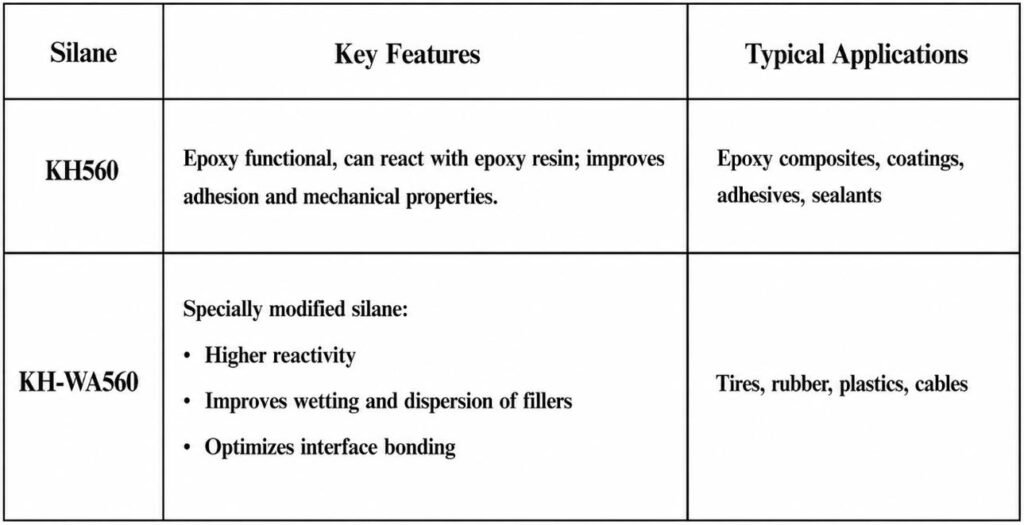
Other Applicable Grades: KH560 (reacts via epoxy and carboxyl groups) and KH570 (participates in vulcanization via free radicals).
(2) Peroxide Vulcanization Systems (e.g., molded EPDM parts, silicone rubber)
Key Coupling Agents: A-172 / A-171
Mechanism:
The vinyl group (CH₂=CH-) participates in peroxide-initiated free-radical crosslinking, thereby directly integrating into the rubber network.
The hydrolysis rate of the methoxy group (in A-171) is faster than that of the ethoxy group (in A-172), making it more suitable for rapid processing applications.
Supporting Data:
In EPDM/A-172 composites, tensile strength was enhanced by 40% (J. Appl. Polym. Sci., 2018).
In silicone rubber, A-171 increased adhesion strength to metals by up to 200% (Momentive Tech. Bulletin).
Other Applicable Grades: KH570 (where the methacryloxy group participates in copolymerization); KH550 (where the amino group catalyzes peroxide decomposition; requires cautious use).
4.The Dual Role of Interfacial Interactions between Powders and Rubber
Comparative Effects:
SI-69: Strong covalent bonding → High reinforcement, low heat generation (in tire applications).
KH550: Hydrogen bonding between amino groups and silica + Polar interactions with NBR → Enhances the strength of the NBR/silica system; however, the plasticizing effect may reduce crosslink density.
5.Key Process Parameters and Optimization Strategies
In-situ Modification (In-situ Silanization): Internal Mixer Compounding
Compounding Temperature: 140–160°C (to promote the condensation reaction).
Duration: 3–7 minutes (to avoid high-temperature degradation).
Filler Pre-treatment:
Hydrolysis Temperature: 50–80°C (using a water/ethanol solution).
Drying Conditions: 110°C for 2 hours (to remove solvents and complete the condensation reaction).
Risk of Failure:
Insufficient moisture → Incomplete hydrolysis → Reduced coupling efficiency.
Excessively high temperature → Decomposition of Y-groups (e.g., oxidation of the amino group in KH550).
6.Global Research Progress and Innovation Directions
Environmentally Friendly Silanes:
TESPT (SI-69) Alternatives: Low-volatility disulfide silanes.
Multifunctional Coupling Agents:
Mercapto-vinyl bifunctional silanes (e.g., VS-SH), compatible with both sulfur and peroxide curing systems (US Patent 10,000,000B1).
Bio-based Silanes:
Silanes derived from plant oils (e.g., products from Croda), reducing carbon footprints (Green Chem., 2021).
Conclusion:
The selection of silane coupling agents requires strict matching with the specific rubber type, vulcanization system, and filler characteristics:
Sulfur Vulcanization: SI-69 is the preferred choice (incorporating polysulfide linkages into the cross-linked network).
Peroxide Vulcanization: Select A-171 or A-172 (utilizing vinyl groups to participate in free-radical cross-linking).
Polar Rubbers: KH550 or KH560 are used to enhance interfacial adhesion via their polar and reactive functional groups.
From a processing standpoint, it is essential to control the tripartite balance of temperature, moisture, and time to achieve optimal coupling efficiency.