Address
Room 2301C, 23rd Floor, Building 1, jinghu Commercial center, No, 34, Liangzhuang Street, Eri District, Zhengzhou City, Henan province
Work Hours
Monday to Friday: 7AM - 7PM
Weekend: 10AM - 5PM
Address
Room 2301C, 23rd Floor, Building 1, jinghu Commercial center, No, 34, Liangzhuang Street, Eri District, Zhengzhou City, Henan province
Work Hours
Monday to Friday: 7AM - 7PM
Weekend: 10AM - 5PM

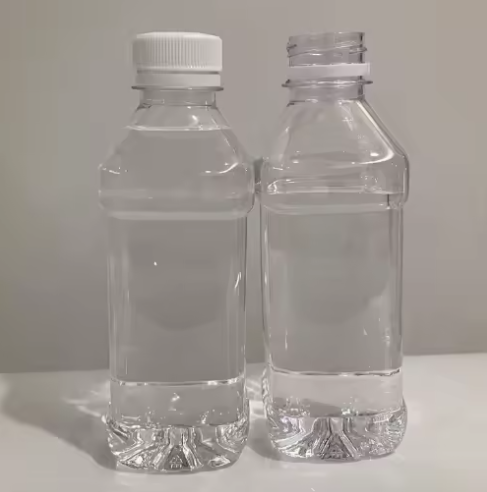
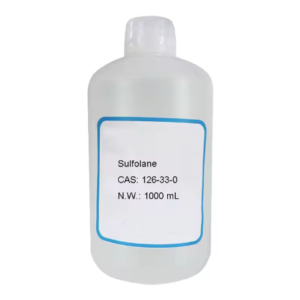
Sulfolane—chemically known as tetrahydrothiophene-1,1-dioxide—is a high-boiling, aprotic polar solvent. Its molecular structure consists of a five-membered ring containing one sulfur atom and two oxygen atoms (forming a sulfone group). This substance was first successfully developed by Shell in the 1940s and quickly gained widespread application within the petrochemical and natural gas industries.
As an excellent solvent, sulfolane possesses exceptional dissolving power and high selectivity. It exhibits a strong affinity for aromatic hydrocarbons (such as benzene, toluene, and xylene) while demonstrating low solubility toward aliphatic hydrocarbons. This characteristic makes it an ideal extractant for the industrial recovery of aromatics from reformate, and it is widely utilized in the production processes for benzene, toluene, and xylene (BTX).
Aromatic extraction constitutes the primary application field for sulfolane. In the petroleum refining industry, sulfolane is frequently employed as an extraction solvent to recover benzene, toluene, and xylene (BTX) from catalytic reformate or cracked gasoline. By leveraging sulfolane’s high solubility for aromatics—and conversely, its low solubility for non-aromatics (aliphatic and naphthenic hydrocarbons)—aromatics can be efficiently separated from complex hydrocarbon mixtures through a liquid-liquid extraction process. The Sulfolane Aromatic Extraction (SAE) process developed by Sinopec is characterized by high product purity, high yield, and strong adaptability, and it is widely utilized in domestic refineries.
Sulfolane also serves as a key solvent in the purification of natural gas and synthesis gas. It is often used in combination with diisopropanolamine (DIPA) or methyldiethanolamine (MDEA) to form the “Sulfolane-Amine” desulfurization process. This method capitalizes on sulfolane’s high solubility for acidic gases (such as H₂S and CO₂) alongside the chemical absorption capabilities of amines; this dual action enables the efficient removal of acidic components from gas streams, thereby meeting the stringent industrial requirements for purified gases.
In the fields of fine chemicals and organic synthesis, sulfolane frequently functions as a reaction medium or solvent. Due to its high polarity, high boiling point, and excellent thermal stability, it facilitates a variety of reactions—including Friedel-Crafts acylation, halogen exchange, oxidation, and nitration—thereby enhancing reaction rates and product yields. Furthermore, sulfolane can serve as a solvent for polymers or as a spinning solvent in the production of materials such as polyacrylonitrile and polyvinyl chloride, contributing to improved fiber properties.
Product Specifications:
| Item | Quality Index | Analyse Method |
| Appearance | colorless or canary lucid liquid | Eyeballing |
| Density(30°C) kg/m3 | 1260-1270 | ASTM D 4052 |
| 5%Distil of temperature °C | ≥282 | ASTM D 1078 |
| 95% Distil of temperature °C | ≤288 | |
| Thermal stability mgSO2/kg | ≤20 | UOP 599 |
| Moisture %(m/m) | ≤3.0 | UOP 481 |
| Sulfur Content %(m/m) | 26.0-27.0 | ASTM D 1078 |
| 2-Sulfolene %(m/m) | ≤0.2 | UOP 608 |
| Isopropyl sulfolane eather %(m/m) | ≤0.2 | UOP 608 |
| Ash content %(m/m) | ≤0.1 |
ASTM D 482 |
Package:
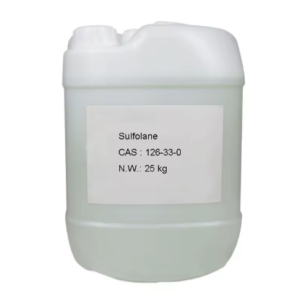
1kg/25kg Bucket
Palletized Shipping
Lead Time: 1-7 Days
Shipping Methods: Sea/Air/Express delivery